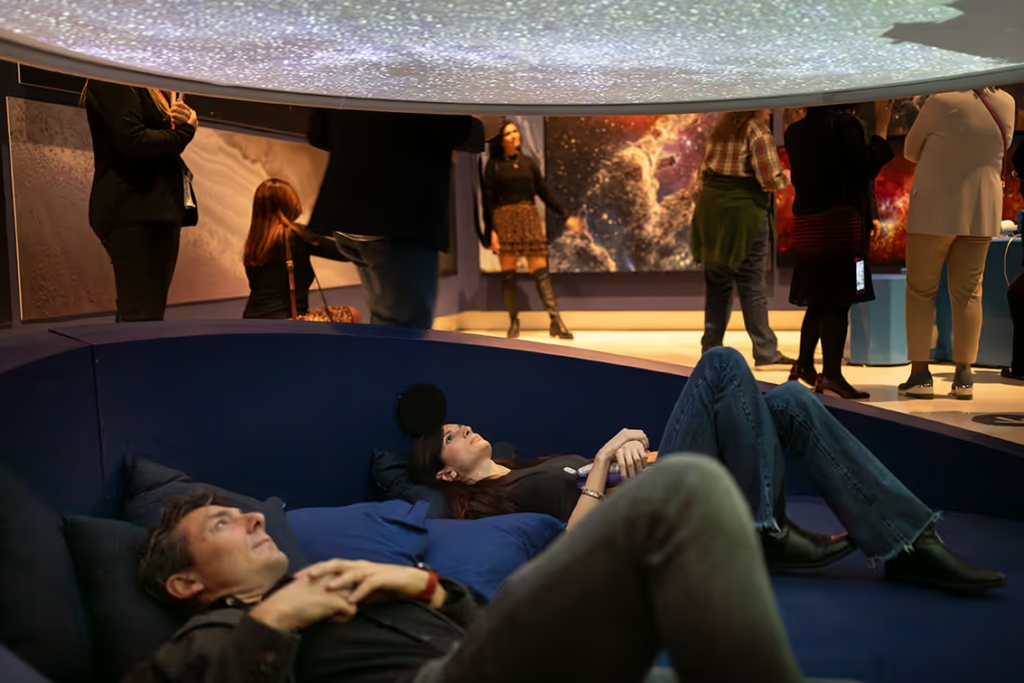
The exhibition unfolds across four spaces. It begins immediately with an immersive experience: leaving planet Earth behind, you fly through the planets of the Solar System and beyond, towards the exoplanets orbiting other stars. To explore our cosmic neighborhood, the Solar System has been recreated on the scale of the Mediterranean, with Matera standing in for the Sun, reproduced 400 million times smaller than the real one. Visitors to the exhibition can discover where, on this scale, the various celestial bodies orbiting it would be located, thus grasping the enormity of interplanetary distances. Planets, comets, and asteroids are reimagined in a playful version with a real 1980s-style arcade. You can also get lost in the Astrophysical Cody Maze, a maze from which you can only escape by correctly answering astronomy questions. The journey continues among planets, stars, galaxies, and gigantic galaxy clusters, encompassing the immense cosmic scales that the Time Machines of contemporary astrophysics strive to grasp, all the way back to the dawn of the universe. The journey culminates in a veritable "art gallery" celebrating the astonishing beauty of the cosmos, immortalized by our telescopes and scientific instruments, which peer into the cosmos across all wavelengths of the electromagnetic spectrum, from every continent on our planet and even in orbit aboard satellites and space probes. Through a combination of iconic images, interactive exhibits, and innovative technologies such as virtual reality, visitors to the exhibition will come into direct contact with the challenges of research that, day after day, pushes the limits of our knowledge ever further.